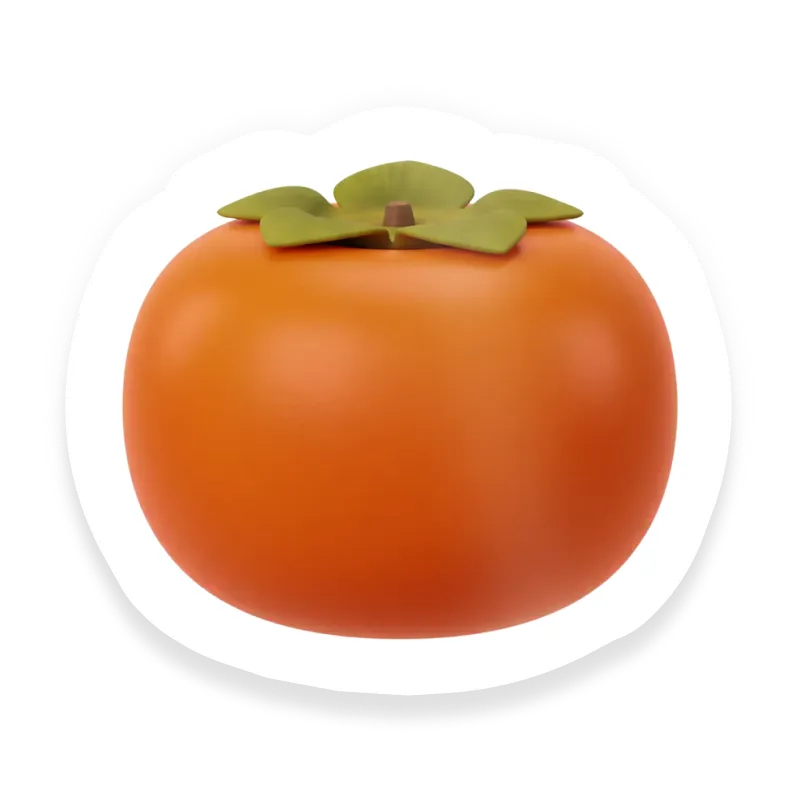
Persimmon
Fruit
Is Persimmon Safe for Babies?
Yes, babies can eat ripe persimmon starting at around 6 months, ensuring it is soft and ripe to prevent choking.
Yes, but there are some things to know
How Do You Serve Persimmon?
- 1Use very soft, jelly-like Hachiya persimmons: cut in half and scoop the custardy flesh with a spoon, or mash it smooth for spoon-feeding.
- 2For Fuyu persimmons, wait until they are easily mashed; peel and remove any seeds or core, then offer a large wedge for self-feeding or cook and puree for a smooth texture.
- 3Check the texture and peel if the skin is tough or stringy; remove seeds and smooth out any lumps to lower choking risk.
- 4Combine persimmon puree with yogurt, oats, or mashed banana, or cool cooked persimmon before serving to introduce new flavors.
Is Persimmon a Common Allergen?
Persimmons are not a common major allergen for most children, but some people can develop oral allergy syndrome (mouth itching/tingling) from cross-reactivity with pollen; rare true IgE-mediated persimmon allergies have been reported. Unripe/astringent persimmons contain high tannins and can be astringent or cause digestive upset, and firm pieces could be a choking risk for young children—serve ripe fruit cut into age-appropriate pieces. Introduce slowly on first offering, watch for hives, swelling, vomiting, or breathing problems, and seek medical care for any systemic reaction.
What Nutrients Does Persimmon Have?
Persimmons provide carbohydrates, fluid and fiber and are good sources of vitamin A (beta‑carotene), vitamin C, vitamin E, vitamin K, vitamin B6, potassium, and antioxidants such as lutein and zeaxanthin — nutrients that support vision, immune function, skin and growth in babies. They are not a meaningful source of iron, though the vitamin C in persimmon can help enhance iron absorption from other foods. Serve only ripe, very soft persimmon in age‑appropriate textures and avoid dried or unripe fruit; large amounts (or firm/dried pieces) raise choking risk and very high intake may cause transient digestive upset or, rarely, bezoar formation.
Is Persimmon a Choking Hazard?
Moderate Choking Risk
Some persimmon varieties can be firm and slippery even when ripe, which raises the risk of choking. Watch closely for signs like persistent coughing, gagging, or difficulty breathing and stay within arm’s reach during meals so you can intervene quickly. It’s a good idea to know basic infant choking first aid so you’re prepared to act if needed.
Have More Questions?
Yes. Persimmons can be introduced to babies around 6 months of age once they are ready for solids, but ensure the fruit is fully ripe and soft to minimize choking risks.
Yes. Persimmons are nutritious and provide vital vitamins and antioxidants that support your baby's growth, immune system, and overall health.
No. Persimmon allergies are rare, but those with birch pollen allergies or latex sensitivities may react. Always introduce a small amount first and watch for reactions.
Yes. Firm or slippery ripe persimmons can pose a choking hazard for babies. Always ensure the fruit is very soft and properly prepared for safe eating.
No. Dried persimmon is too firm and can be a choking risk. Instead, serve fresh, ripe persimmons or rehydrate and finely chop dried ones if necessary.
Is Persimmon safe for your baby?
Get personalized guidance on introducing Persimmon — with prep tips, allergen alerts, and age-specific serving ideas.
Sources
- Astringency: a more stringent definition. (Jiang et al., 2014) doi.org
- Allergy caused by ingestion of persimmon (Diospyros kaki). (Anliker et al., 2001) doi.org
- Oral Allergy Syndrome in Birch Pollen-Sensitized Patients (Kim et al., 2018) doi.org
- Latex-Fruit Anaphylaxis from Persimmon (Pradubpongsa & Kanechorn-Na-Ayuthaya, 2015) doi.org
- Patient Education: Oral Allergy Syndrome (Beyond the Basics) (Nowak-Regrzyn, 2021) - UpToDate uptodate.com
- If Allergic to One Food, Do You Have to Avoid Related Foods? (Mankad, 2015) - Kids with Food Allergies kidswithfoodallergies.org
- Gastrointestinal bezoars: history and current treatment paradigms (Eng & Kay, 2012) gastroenterologyandhepatology.net
- Gastrointestinal phytobezoars in childhood (Soon-Ok Choi & Joong-Shin Kang, 1988) doi.org
- Persimmon fruit causing simultaneous small bowel and stomach obstruction (Teng et al., 2019) doi.org
- Small bowel obstruction in children due to persimmon phytobezoars (Zafar et al., 2003) pubmed.ncbi.nlm.nih.gov
- Huge gastric disopyrobezoar: a case report and review of literatures (Zhang et al., 2008) doi.org
What Other Fruit Can Babies Eat?
See all →



Backed by Science
Data you can trust.
Every food, guideline, and recommendation in Tummi is sourced from leading health institutions and peer-reviewed research.
 Centers for Disease Control and Prevention
Developmental milestones, nutrition guidelines, and allergen introduction timelines.
 American Academy of Pediatrics
Evidence-based feeding recommendations from the leading pediatric authority.
 National Institutes of Health
Peer-reviewed research on infant nutrition, allergies, and food safety.