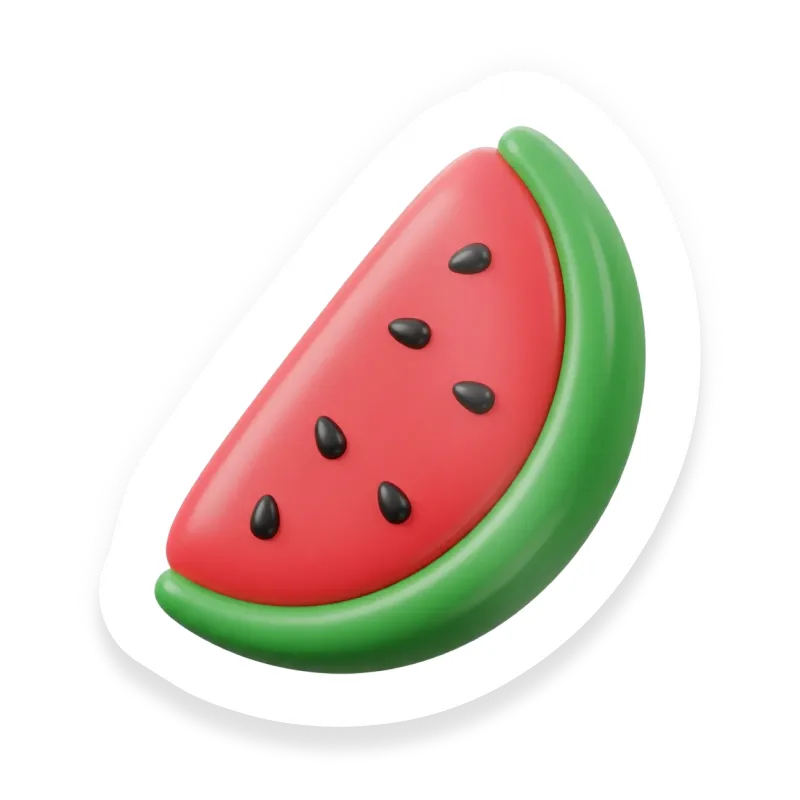
Watermelon
Fruit
Is Watermelon Safe for Babies?
Yes, after 6 months, cut into small, manageable pieces and served plain to introduce watermelon to babies.
Yes, but there are some things to know
At a Glance
Watermelon has a high water content (about 91–92%) plus small amounts of fiber and potassium, which help soften stool. This mix of fluids and fiber can aid bowel movements and support regular digestion.
How Do You Serve Watermelon?
- 1Serve watermelon on a thick piece of rind with most flesh removed so the rind acts as a teether and is easy for little hands to hold.
- 2Or cut into thin rectangular sticks about the width of two adult fingers and the thickness of a ruler — remove all seeds first.
- 3Wash the melon before cutting and trim away any slippery or loose rind pieces to reduce choking risk.
- 4Watch closely while the baby feeds because watermelon’s high liquid content can cause coughing or gagging as they learn to manage mixed textures.
Is Watermelon a Common Allergen?
Watermelon is not one of the common top-9 food allergens for most children, but people with pollen allergies (especially ragweed) can develop oral allergy syndrome — mild itching or swelling of the mouth and throat after eating it. True systemic allergic reactions to watermelon are uncommon, though documented. For infants and young children, remove seeds and serve in small, manageable pieces to reduce choking risk and introduce it after other solids are tolerated. If you see hives, throat tightness, vomiting, or breathing difficulty after eating watermelon, seek medical care immediately.
What Nutrients Does Watermelon Have?
Watermelon is mostly water and simple carbohydrates and provides fiber, potassium, magnesium, vitamins A and C, and the antioxidant lycopene—nutrients that help with hydration, electrolyte balance, immune support, vision/skin health, and antioxidant protection. It’s a generally low-allergen, baby-friendly fruit and an easy way to add hydration and vitamin C to a baby’s diet, but it is not a source of iron. Because watermelon is >90% water and relatively high in natural sugars, large amounts can cause loose stools; introduce small portions and monitor tolerance.
Is Watermelon a Choking Hazard?
Low Choking Risk
Watermelon’s high-water content plus soft flesh creates a “mixed consistency” that often causes coughing and gagging as babies learn to manage juice and solids; watermelon seeds can pose an aspiration risk. The rind can be a choking hazard if chewed or bitten off in large pieces. Closely supervise babies while they eat and be ready to respond if they show signs of choking or breathing difficulty.
Have More Questions?
It depends. Watermelon can be stored in the refrigerator for a few days once cut, but it is best to consume it within 1-2 days for optimal freshness and safety.
Yes. You can freeze watermelon puree or chunks, which can be thawed and served later, but freezing may alter the texture slightly.
It depends. Choosing organic watermelon reduces pesticide exposure, but conventionally grown watermelon is also safe if thoroughly washed before serving to babies.
Yes. Combining watermelon with other fruits or foods can introduce your baby to new flavors and textures, helping with taste development and food acceptance.
It depends. Typical portion sizes for babies start around 1-2 ounces of watermelon, depending on age and appetite, and should be offered in manageable, age-appropriate pieces.
Is Watermelon safe for your baby?
Get personalized guidance on introducing Watermelon — with prep tips, allergen alerts, and age-specific serving ideas.
Sources
- Quantification of Lycopene, β-Carotene, and Total Soluble Solids in Intact Red-Flesh Watermelon (Tamburini et al., Sensors, 2017) doi.org
- Influence of L-citrulline and watermelon supplementation on vascular function and exercise performance (Figueroa et al., 2017) doi.org
- Food safety tips for melons (Government of Canada, 2013) canada.ca
- Oral allergy syndrome (American Academy of Allergy, Asthma & Immunology, 2020) aaaai.org
- Oral and systemic symptoms in children with fruit allergy (Kato et al., Arerugi, 2018) doi.org
- Randomized, double-blind, crossover challenge study in 53 subjects reporting adverse reactions to melon (Rodriguez et al., J Allergy Clin Immunol, 2000) doi.org
- Foreign body aspiration in children: experience of 1160 cases (Eren et al., Ann Trop Paediatr, 2003) doi.org
- Tracheobronchial foreign body aspiration in children (Mallick, Afr J Paediatr Surg, 2014) doi.org
- Rigid bronchoscopy for the suspicion of foreign body in the airway (Aydoğan et al., Int J Pediatr Otorhinolaryngol, 2006) doi.org
- Watermelon, raw (U.S. Department of Agriculture, FoodData Central, 2019) fdc.nal.usda.gov
What Other Fruit Can Babies Eat?
See all →


Backed by Science
Data you can trust.
Every food, guideline, and recommendation in Tummi is sourced from leading health institutions and peer-reviewed research.
 Centers for Disease Control and Prevention
Developmental milestones, nutrition guidelines, and allergen introduction timelines.
 American Academy of Pediatrics
Evidence-based feeding recommendations from the leading pediatric authority.
 National Institutes of Health
Peer-reviewed research on infant nutrition, allergies, and food safety.