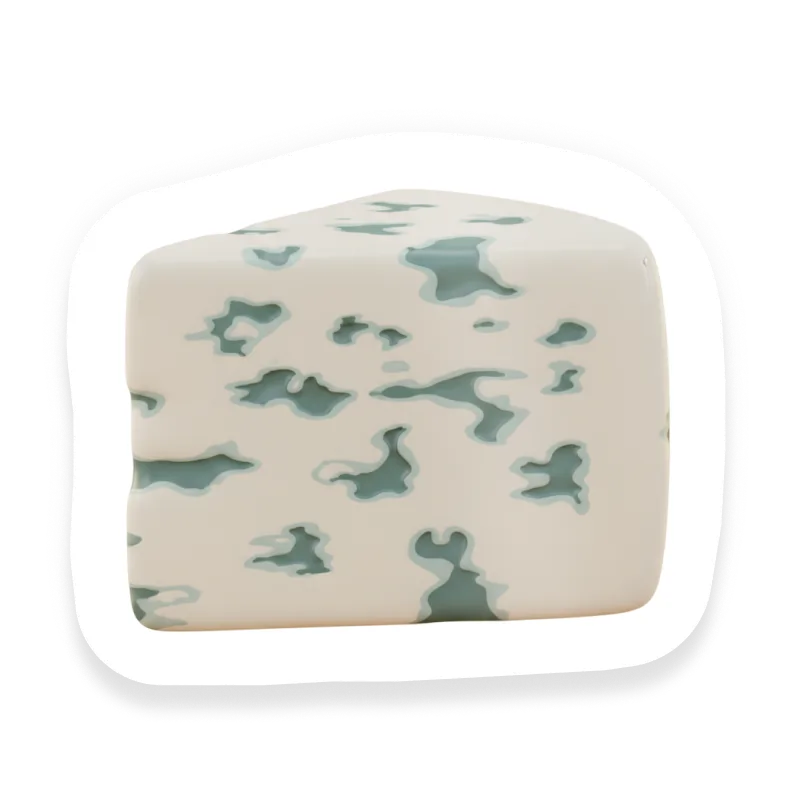
Blue Cheese
Dairy
Is Blue Cheese Safe for Babies?
No, blue cheese is not recommended for babies under 12 months due to the risk of foodborne illnesses like Listeria.
Yes, but there are some things to know
At a Glance
Blue cheese can trigger allergic reactions in people who are sensitive to dairy because it contains cow's milk proteins such as casein and whey. Its blue mold cultures and higher histamine content can also cause sensitivities in some individuals.
How Do You Serve Blue Cheese?
- 1Delay offering blue cheese (e.g., Roquefort, Gorgonzola) because it's often made from unpasteurized milk and can carry Listeria; avoid soft cheeses until a clinician advises it's safe.
- 2Choose safer pasteurized options such as emmental, fresh mozzarella, ricotta, paneer, labneh, goat cheese, mascarpone, or Swiss. Serve in small, soft pieces or mashed to reduce choking risk.
- 3If there's a history of milk allergy or previous reactions, check with clinician before introducing dairy; introduce new cheeses one at a time and watch for symptoms for several days.
- 4When preparing, use only pasteurized cheeses, refrigerate promptly, and discard if left at room temperature for more than 2 hours.
Is Blue Cheese a Common Allergen?
Blue cheese is a dairy cheese (made from cow, sheep, or goat milk) and contains milk proteins—do not give to children with a milk/dairy allergy. It is ripened with Penicillium molds; ingestion rarely causes the same reactions as inhaled mold, but people with known mold sensitivity should use caution. Check labels for pasteurization and allergen warnings, and avoid blue cheese made from unpasteurized milk or any product if a child has a severe dairy allergy.
What Nutrients Does Blue Cheese Have?
Nutrient Snapshot: Blue cheese is a calorie- and fat-dense dairy that provides concentrated sources of calcium and high-quality protein important for bone growth and general development, plus smaller amounts of vitamin B12, zinc, and fat‑soluble vitamins. Because it’s an aged, salty cheese, it is also relatively high in sodium and saturated fat, so offer only small portions and not regularly. For babies, the main benefits are calcium and protein; however, blue cheese is a common dairy allergen and can contain histamines, so introduce only pasteurized varieties after 12 months and start with a tiny amount while monitoring for reactions. Avoid unpasteurized blue cheese entirely and limit frequency to prevent excess sodium and saturated fat intake.
Is Blue Cheese a Choking Hazard?
Very Low Choking Risk
High choking risk. Blue cheese can become firm or form sticky, globby masses that are difficult for babies to manage and increase the chance of choking. Always stay within arm’s reach while your child is eating blue cheese and be prepared to recognize and respond to choking.
Have More Questions?
It depends. Blue cheese can be safe if pasteurized and baked to an internal temperature of at least 165°F, but it's recommended to wait until your baby is at least 12 months old due to foodborne illness risks.
No. Unpasteurized blue cheese carries a high risk of foodborne illness for babies and young children, so it should be avoided entirely.
It depends. Blue cheese made from pasteurized milk can be introduced after 12 months if baked properly, but always consult your pediatrician before introducing mold-ripened cheeses.
Yes, in an airtight container in the refrigerator, but ensure it is well-wrapped and consumed within a week for safety and quality.
It depends. Blue cheese is a common dairy allergen, so check if your baby has a dairy allergy or intolerance before offering it, and consult your doctor if unsure.
Is Blue Cheese safe for your baby?
Get personalized guidance on introducing Blue Cheese — with prep tips, allergen alerts, and age-specific serving ideas.
Sources
- Modeling the growth of Listeria monocytogenes on the surface of smear- or mold-ripened cheese - Schvartzman et al., Frontiers (2014) frontiersin.org
- Listeria infections - KidsHealth (2017) kidshealth.org
- Food safety for babies and young children - NHS nhs.uk
- Cheese Microbial Risk Assessments - A Review - Choi et al., Asian-Australasian Journal of Animal Sciences (2016) doi.org
- Consumption of raw or unpasteurized milk and milk products by pregnant women and children - AAP Pediatrics (2014) pediatrics.aappublications.org
- Listeria - European Food Safety Authority (EFSA, 2019) efsa.europa.eu
- The epidemiology of milk allergy in US children - Warren et al., Annals of Allergy, Asthma & Immunology (2013) doi.org
- The challenge of cow milk protein allergy - El-Agamy (2007) doi.org
- Histamine Intolerance: The Current State of the Art - Comas-Basté et al., Biomolecules (2020) doi.org
- Histamine Intolerance in Children: A Narrative Review - Nazar et al., Nutrients (2021) doi.org
- Food protein-induced enterocolitis syndrome and allergic proctocolitis - Nowak-Węgrzyn (2015) doi.org
- Food Protein-Induced Enterocolitis Syndrome (FPIES) - National Organization for Rare Disorders (2019) rarediseases.org
- Living with lactose intolerance - InformedHealth (IQWiG, 2010) informedhealth.org
What Other Dairy Can Babies Eat?
See all →
Backed by Science
Data you can trust.
Every food, guideline, and recommendation in Tummi is sourced from leading health institutions and peer-reviewed research.
 Centers for Disease Control and Prevention
Developmental milestones, nutrition guidelines, and allergen introduction timelines.
 American Academy of Pediatrics
Evidence-based feeding recommendations from the leading pediatric authority.
 National Institutes of Health
Peer-reviewed research on infant nutrition, allergies, and food safety.