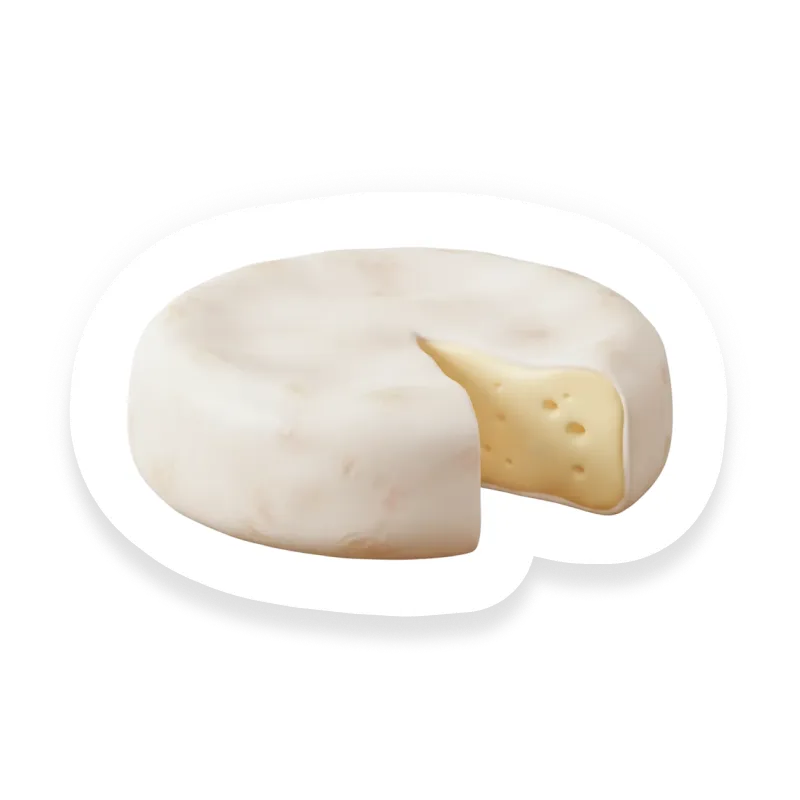
Camembert Cheese
Dairy
Is Camembert Cheese Safe for Babies?
No, raw or unpasteurized camembert cheese is not safe for babies due to the high risk of foodborne illness. Use only pasteurized cheese and consider baking it to reduce risks.
Yes, but there are some things to know
At a Glance
Camembert can trigger milk protein allergy in sensitive people because it contains the milk proteins casein and whey. It is also rich in calcium and high in protein, which help build strong bones and muscles.
How Do You Serve Camembert Cheese?
- 1Delay offering camembert because mold-ripened soft cheeses have a higher risk of foodborne bacteria like Listeria.
- 2If you choose to offer a very small taste, use only pasteurized camembert and heat to 165°F (74°C) until steaming hot, then cool completely before serving.
- 3Spread a thin smear on well-toasted bread or another soft, age-appropriate base to limit portion size and reduce choking risk.
- 4Start with a tiny amount and observe for any adverse reaction over the next 48 hours; skip it if there’s a family history of severe dairy allergy.
Is Camembert Cheese a Common Allergen?
Camembert is a soft, surface-ripened cow’s milk cheese and therefore contains dairy (milk proteins). People with milk allergy or severe dairy sensitivity should avoid Camembert, as milk proteins can trigger reactions ranging from hives and vomiting to breathing difficulties. If you suspect a milk allergy, consult a healthcare professional and choose dairy-free alternatives when necessary.
What Nutrients Does Camembert Cheese Have?
Camembert is nutrient-dense—providing protein, calcium and phosphorus for bone and muscle growth, B‑vitamin (including B12) for brain and nervous‑system development, and energy‑rich fat that supports rapid infant growth. These nutrients can benefit toddlers (12+ months for pasteurized camembert) but the cheese is also relatively high in saturated fat and sodium and, as a dairy product, a common allergen; excessive intake can displace iron‑rich foods and contribute to unhealthy fat/salt intake. Introduce pasteurized camembert cautiously after 12 months, offer small amounts as part of a varied diet, and consult a pediatrician if there is a family history of allergy or concern.
Is Camembert Cheese a Choking Hazard?
Low Choking Risk
Camembert can be soft but sticky and often forms a glob in the mouth, which increases the risk of choking in young children. Because of that, stay within arm’s reach and closely watch a child when they eat it, and be prepared to act quickly if they gag or choke. Learn the signs of choking and basic infant/toddler choking first aid so you can respond confidently if needed.
Have More Questions?
Yes. It is safer if pasteurized and served at the appropriate age, which is usually after 12 months, to minimize the risk of foodborne illness in babies.
Yes, but only if it is pasteurized and given when your baby is at least 12 months old. Baking it to an internal temperature of 165 F (74 C) further reduces health risks.
Yes. Since camembert is made from cow's milk, it is considered a common allergen, especially in young children, and should be introduced cautiously.
Yes. Due to its soft, sticky texture, camembert can pose a choking hazard unless prepared appropriately for your child's age and eating skills.
There is no safe age for unpasteurized camembert due to the high risk of foodborne illness, and it is best avoided entirely for babies and young children.
Is Camembert Cheese safe for your baby?
Get personalized guidance on introducing Camembert Cheese — with prep tips, allergen alerts, and age-specific serving ideas.
Sources
- Committee on Infectious Diseases; Committee on Nutrition; American Academy of Pediatrics (2014). Consumption of raw or unpasteurized milk and milk products. Pediatrics. pediatrics.aappublications.org
- Schvartzman MS et al. (2014). Modeling the growth of Listeria monocytogenes on the surface of smear- or mold-ripened cheese. Frontiers in Cellular and Infection Microbiology. frontiersin.org
- Choi KH et al. (2016). Cheese Microbial Risk Assessments - A Review. Asian-Australasian Journal of Animal Sciences. doi.org
- Centers for Disease Control and Prevention (2019). Listeria — Prevention. cdc.gov
- National Health Service (2018). Foods to avoid giving babies and young children. nhs.uk
- European Food Safety Authority (2019). Listeria. efsa.europa.eu
- Warren CM et al. (2013). The epidemiology of milk allergy in US children. Annals of Allergy, Asthma & Immunology. doi.org
- Nowak-Węgrzyn A. (2015). Food protein-induced enterocolitis syndrome and allergic proctocolitis. Allergy Asthma Proc. doi.org
- U.S. Food & Drug Administration. Dangers of raw milk. fda.gov
- Centers for Disease Control and Prevention. Raw Milk information. cdc.gov
- InformedHealth.org (IQWiG) (2010). Living with lactose intolerance. ncbi.nlm.nih.gov
What Other Dairy Can Babies Eat?
See all →
Backed by Science
Data you can trust.
Every food, guideline, and recommendation in Tummi is sourced from leading health institutions and peer-reviewed research.
 Centers for Disease Control and Prevention
Developmental milestones, nutrition guidelines, and allergen introduction timelines.
 American Academy of Pediatrics
Evidence-based feeding recommendations from the leading pediatric authority.
 National Institutes of Health
Peer-reviewed research on infant nutrition, allergies, and food safety.