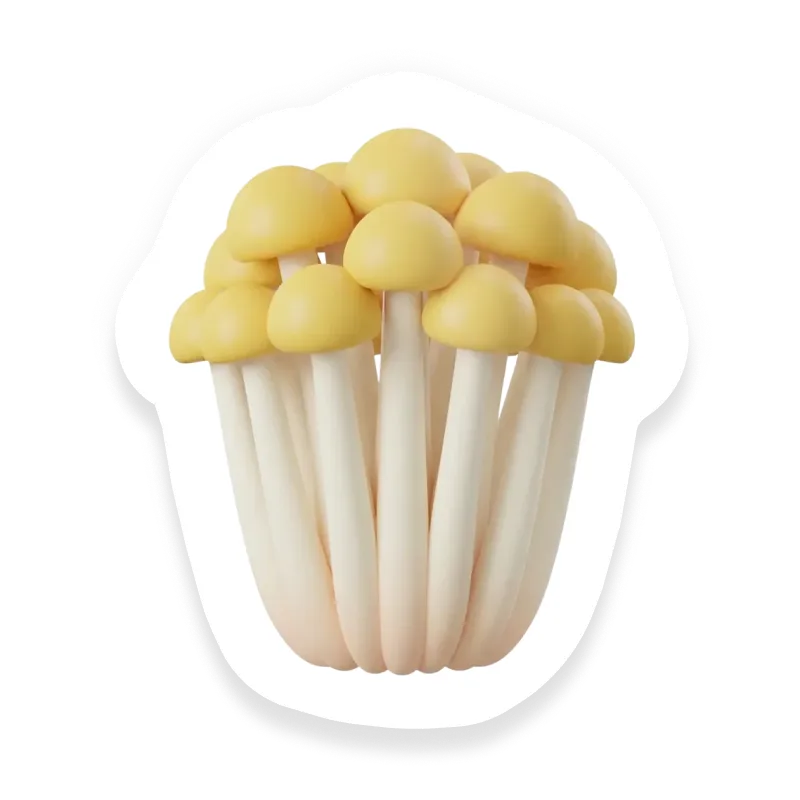
Enoki Mushroom
Fungi
Is Enoki Mushroom Safe for Babies?
Yes, cooked enoki mushrooms can be introduced around 6 months of age, ensuring they are thoroughly cooked and prepared safely.
Yes, but there are some things to know
At a Glance
Enoki mushrooms are low‑calorie and have helpful dietary fiber content that adds bulk and supports regular bowel movements. They also contain mushroom polysaccharides that support gut bacteria as prebiotics, which can improve stool consistency.
How Do You Serve Enoki Mushroom?
- 1Rinse enoki under cold water and trim away the thick root cluster; discard the tough base.
- 2Cook thoroughly by steaming, sautéing, or simmering until very soft (about 3–5 minutes) to reduce choking risk and kill bacteria.
- 3Finely chop both caps and stems, then press or flatten the pieces so they form soft, thin strips rather than round shapes.
- 4Mix small amounts into easy-to-scoop foods like congee, mashed vegetables, soft noodles, or egg strips so textures blend and are easy to grasp.
- 5Let cool to a safe temperature, offer a small test portion first, and always supervise feeding—discard any stringy or chewy pieces.
Is Enoki Mushroom a Common Allergen?
Enoki mushrooms are not a common food allergen, but fungal (mushroom) allergies can occur—watch for hives, swelling, vomiting, or breathing difficulty. More importantly, enoki have been linked to Listeria outbreaks; CDC/FDA and food-safety agencies advise cooking them thoroughly and avoiding raw enoki for infants, pregnant people, older adults, and immunocompromised children. Also verify how mushrooms are prepared, since sauces or cross-contact can introduce common allergens (soy, sesame, gluten, dairy, nuts). For young children, serve cooked enoki in small, soft pieces to reduce choking risk.
What Nutrients Does Enoki Mushroom Have?
Enoki mushrooms supply folate and B vitamins (supporting neurodevelopment), antioxidants and phytonutrients (anti-inflammatory and immune-supporting properties), small amounts of iron and zinc, choline, plus fiber and prebiotic compounds that support healthy digestion and stool patterns. Cooked and finely chopped, they can be a nutrient-dense addition from around 6 months of age. Avoid raw or jarred/preserved enoki (risk of foodborne illness and higher sodium/sulfite exposure); mushrooms are unlikely to cause nutrient excess in normal portions but monitor for rare mushroom allergy and ensure baby gets other iron-rich foods as mushrooms are not a primary iron source.
Is Enoki Mushroom a Choking Hazard?
Low Choking Risk
Enoki mushrooms are a notable choking risk because they’re firmer than many mushrooms and have small, round caps that can lodge in a baby’s airway. To lower the risk, cut both caps and stems so pieces are no longer round, and make sure any dried pieces are fully softened and then cut as needed. Always stay within arm’s reach and closely supervise mealtime so you can respond quickly if gagging or choking occurs.
Have More Questions?
It depends. Cooked enoki mushrooms can be introduced around 6 months, but always ensure they are thoroughly cooked and given in appropriate sizes to avoid any feeding issues.
Yes. Cooked enoki mushrooms can be stored in an airtight container in the refrigerator for up to 2 days, ensuring they stay fresh and safe for your baby's consumption.
Yes. Pureed enoki mushrooms can be frozen in small portions for up to 3 months, making it convenient to serve to your baby over time.
Both are safe; however, organic enoki mushrooms are preferred by some parents as they are less likely to contain pesticide residues.
Yes. Enoki mushrooms can be combined with milks, broths, or mixed into purees with vegetables or grains for variety and added nutrients.
Is Enoki Mushroom safe for your baby?
Get personalized guidance on introducing Enoki Mushroom — with prep tips, allergen alerts, and age-specific serving ideas.
Sources
- Golden Needle Mushroom: A Culinary Medicine with Evidenced-Based Biological Activities and Health Promoting Properties (Front Pharmacol, 2016) doi.org
- Mushroom allergy (Allergy, 1988) doi.org
- Cross-reactivity between raw mushroom and molds in a patient with oral allergy syndrome (Ann Allergy Asthma Immunol, 2002) doi.org
- Shiitake mushroom: A poorly known allergen responsible for severe work-related asthma (Int J Occup Med Environ Health, 2014) doi.org
- From respiratory sensitization to food allergy: Anaphylactic reaction after ingestion of mushrooms (Med Mycol Case Rep, 2015) doi.org
- A case of anaphylactic reaction following oyster mushroom inhalation (Int J Occup Med Environ Health, 2021) doi.org
- Chitin, chitinases and chitinase-like proteins in allergic inflammation and tissue remodeling (Yonsei Med J, 2009) doi.org
- Mushroom allergy: Case series (J Allergy Clin Immunol In Pract, 2020) doi.org
- A Critical Review on Health Promoting Benefits of Edible Mushrooms through Gut Microbiota (Int J Mol Sci, 2017) doi.org
- Closing America's Fiber Intake Gap: Communication Strategies From a Food and Fiber Summit (Am J Lifestyle Med, 2016) doi.org
- Oral Allergy Syndrome: An Update for Stomatologists (Journal of Allergy, 2015) doi.org
What Other Fungi Can Babies Eat?
See all →
Backed by Science
Data you can trust.
Every food, guideline, and recommendation in Tummi is sourced from leading health institutions and peer-reviewed research.
 Centers for Disease Control and Prevention
Developmental milestones, nutrition guidelines, and allergen introduction timelines.
 American Academy of Pediatrics
Evidence-based feeding recommendations from the leading pediatric authority.
 National Institutes of Health
Peer-reviewed research on infant nutrition, allergies, and food safety.